What Paper Should You Use for a Zine?
Choose paper by how it prints, folds and feels in the finished booklet.
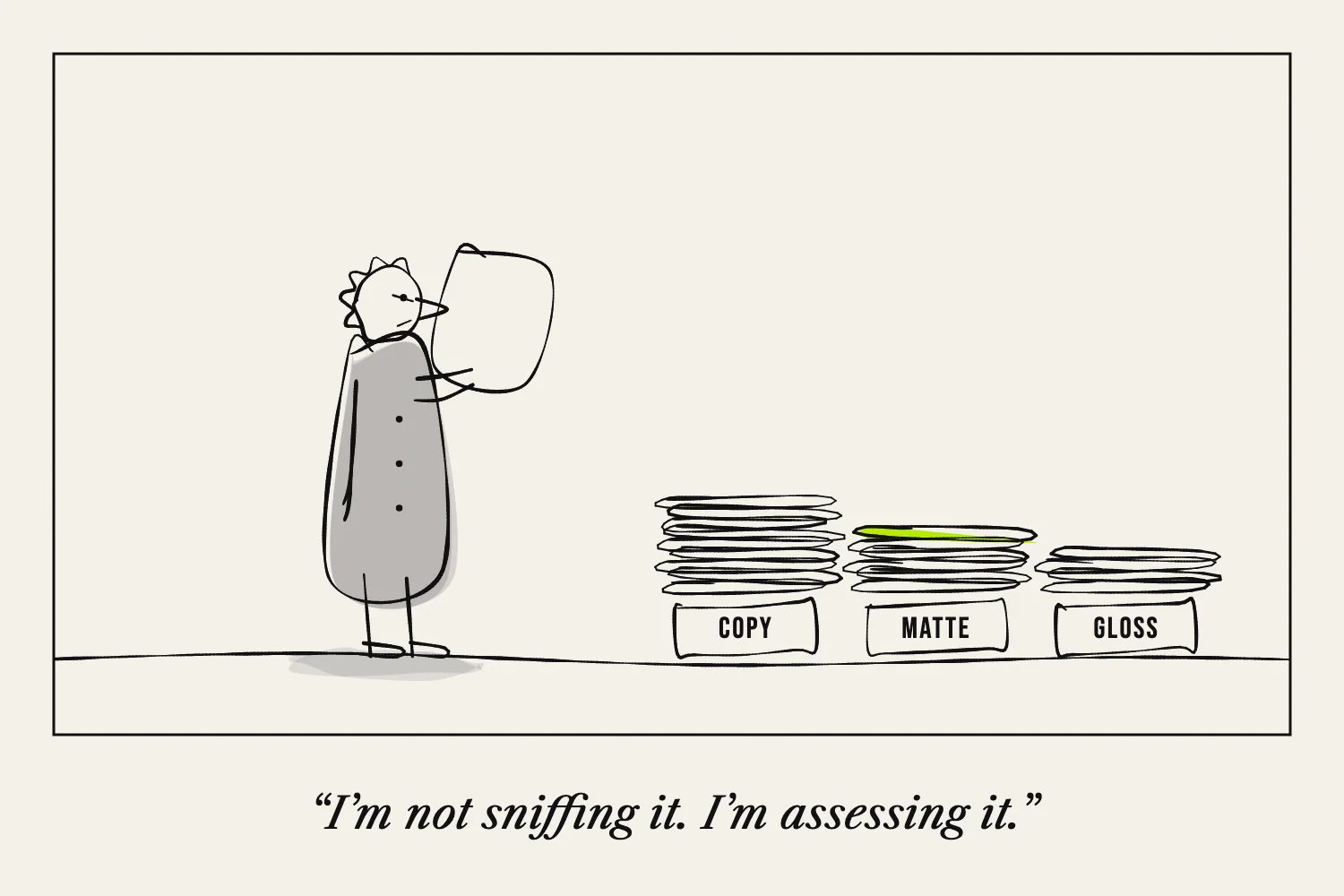
Start with paper that your printer supports and that suits the way the zine will be assembled. For a first one-sheet zine, ordinary copy paper is a useful test material because you can practise without committing to a special stock.
Paper choice becomes easier when you compare the finished result rather than the packet alone.
Decide what matters most
For a text-heavy zine, check readability and whether writing on the reverse shows through. For photographs, check detail in dark and light areas. For a folded one-sheet zine, check whether the finished stack closes comfortably.
A paper that feels substantial as a single sheet may become awkward after several folds. Conversely, a paper that seems thin on its own may suit a small booklet.
Compare surfaces with your own artwork
Print the same sample on the papers you are considering. Include small text, a dark photograph, a light photograph and a large solid area.
Look for smudging, lost detail and any distracting surface glare. Use the correct printer setting for the paper rather than treating every stock as plain paper.
Choose paper sold for the printing process you will use. Check the manufacturer's instructions before putting unfamiliar coated or heavy paper through a home printer.
Test both sides if both will be printed
A sample printed on one side cannot show how a double-sided booklet will look.
Put a dark image behind a light page in the test. If the reverse image distracts from reading, try a different paper, change the page pairing or adjust the design.
Opacity describes how much the paper blocks what is behind it. Weight alone does not tell you how opaque a particular sheet will be.
Make a complete folded sample
Use the planned number of sheets and the intended cover. Check the centre fold and whether the pages spring open.
If the cover is separate, it can use a different paper from the inside pages. Keep the decision practical: the cover still needs to fold and work with the chosen binding.
Paper-weight labels can be confusing. The PaperPapers guide explains why pound ratings depend on the paper category; “80 lb text” and “80 lb cover” are different stocks.
Record the paper you choose
Keep the packet label or write down the manufacturer, product name, size, weight and printer setting. That makes a later reprint easier to reproduce.
Buy a small quantity for testing before ordering enough for a full run. The paper that works for this zine may not be the best choice for the next one.
For the numbers on the label, read What Paper Weight Is Best for Zines?.