The Story of The Comet
A ten-page club bulletin from 1930 helps explain what early fanzines were for.
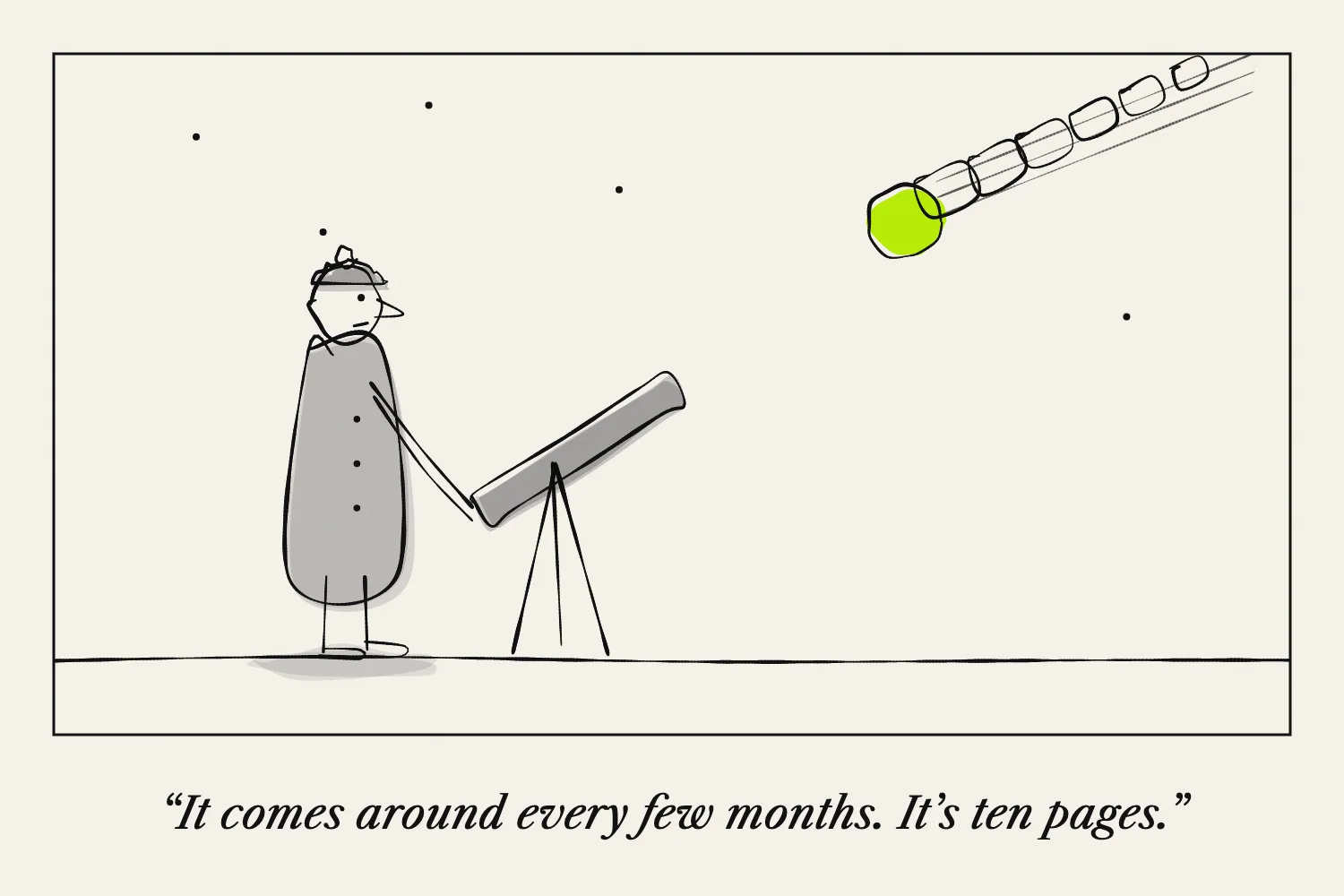
The Comet is often introduced as the first science-fiction fanzine. The surviving archive supports a more careful description: it is one of the earliest publications regularly identified with that tradition.
FANAC's catalogue records its first issue in May 1930, names Ray Palmer and Walter Dennis, and lists ten pages. It was the bulletin of the Science Correspondence Club.
Those details tell us something important before we even discuss its reputation. This was a publication connected to a group of people, made to circulate within a network of shared interests.
What a correspondence club did
“Correspondence” means exchanging letters. A club organised around correspondence could connect people who did not live near one another.
That distinction appears in Allen Glasser's later account of the Scienceers. He contrasted his own local group, which met in person, with the more widely spread Science Correspondence Club. He also acknowledged that the correspondence club helped some people find their way into the local group.
A bulletin made sense in that setting. Instead of every member needing a separate account of the group's activity, a publication could give readers a shared reference point.
Why the title changes in historical accounts
The first issue was called The Comet. Subsequent issues used Cosmology, according to FANAC.
This explains why an account of early fandom might mention Cosmology where another mentions The Comet. A title change can make a small publication harder to follow, particularly when few copies survive or catalogues describe issues differently.
When researching an early zine, search for alternative titles as well as the names of the people who made it. Otherwise, part of the record may appear to be missing.
What “the first” can hide
Calling a publication the first requires a definition. Do we mean the earliest fan-made magazine, a science club bulletin, or the first regularly issued paper of a local science-fiction club?
Glasser's recollection shows that participants themselves disagreed about how to assign these honours. His account was written decades after the events and explicitly relied partly on memory.
That does not make the history unknowable. It means precise wording is more useful than a neat origin story. The Comet is a documented early example; calling it the unquestioned beginning of all zines would claim more than the evidence establishes.
How to approach the archive
Start with the catalogue's date, title and publication details. Then distinguish those details from what you can establish by reading a scan.
A catalogue is evidence that an issue exists and how an archive describes it. It is not a substitute for reading every page. Keeping those two kinds of evidence separate helps us appreciate this small publication without surrounding it with invented certainty.
Read next: Where Did Zines Come From?.