Artists Who Make Zines
Zines can be part of an artist's practice, with possibilities distinct from a single image on a wall.
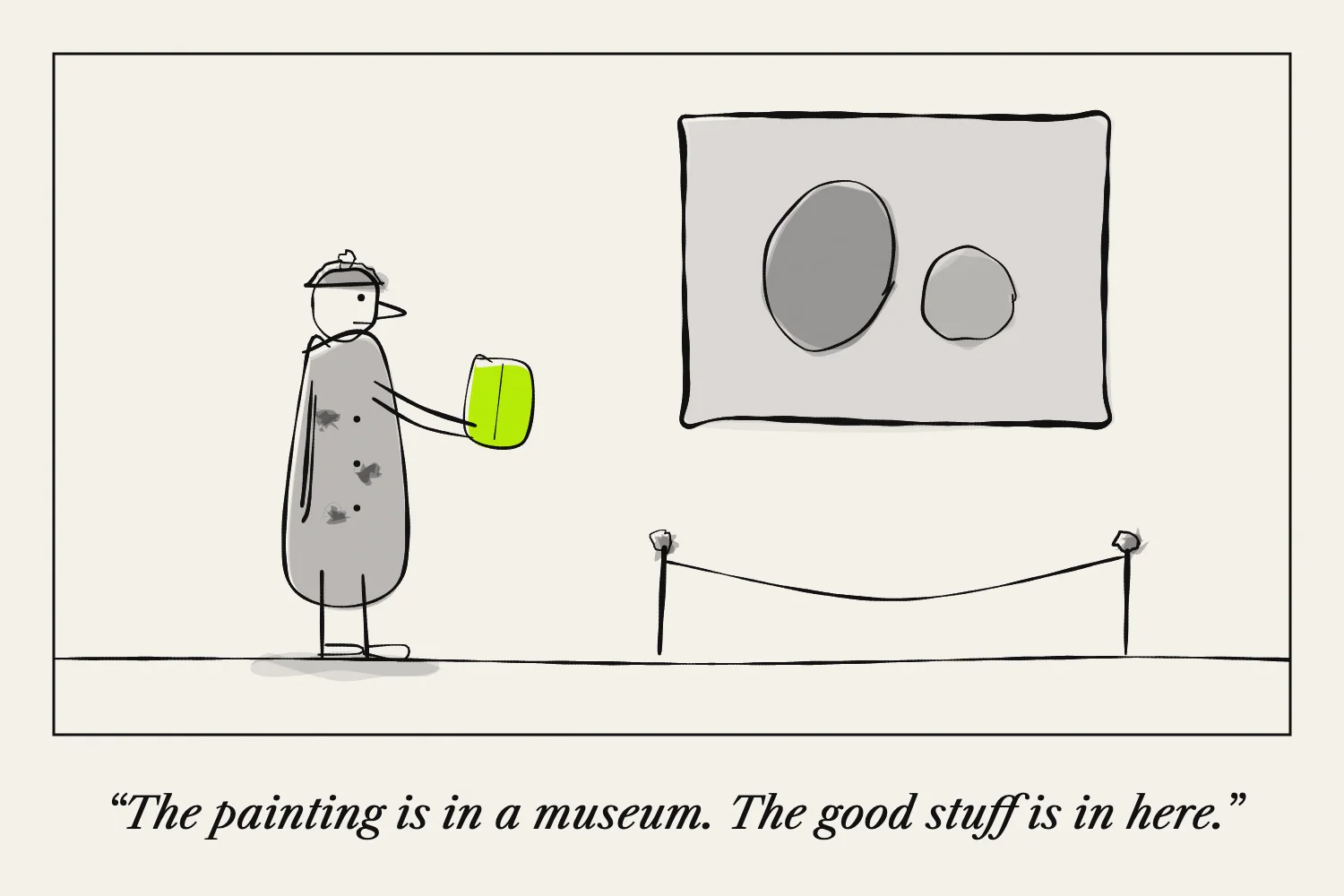
An artist's zine does not have to be a catalogue of work made elsewhere. The publication can be the work: a sequence of drawings, a conversation between images or an experiment shaped by the page.
Three examples show different ways artists have used the form.
Amy Sillman: a publication alongside painting
Amy Sillman's practice includes painting, drawing, animation and the zine series The O.G.
Portikus's account of her 2016 exhibition, The ALL-OVER, identifies the tenth issue as part of the exhibition project. It places publishing alongside the other media she uses rather than treating it as unrelated promotional material.
Her website also makes early issues available as a PDF, offering a direct way to encounter the work.
For a reader, the useful question is how the printed sequence relates to an artist's other decisions. What can the pages put beside one another? What changes when you encounter the work in an order?
John Porcellino: an ongoing relationship with readers
John Porcellino has self-published King-Cat since 1989.
In a 2022 interview with Autobiographix, he describes developing his comics through continued practice and the importance of the community around the publication. The interview also discusses the effort needed to sustain a project as it grows.
The zine combines forms including comics, observations, memories and letters. Its continuing nature creates room for a reader to encounter the maker's work over time, rather than only through a single finished book.
G.B. Jones: images within a publishing collaboration
G.B. Jones co-edited J.D.s with Bruce LaBruce.
Alternative Toronto's record of the 1985 first issue credits Jones with the cover concept, design and spray paint. Those credits identify visual work as part of making the publication itself.
The example also complicates the idea of an artist's zine as a solitary project. Editing, design and contributions can be shared while individual roles remain visible.
Look at what the format makes possible
When exploring artists' zines, notice more than the individual images.
Look at scale, repetition, captions, blank space and page turns. Ask whether the issue is meant to be read in order, opened out or returned to in fragments.
A reproduced image of a cover cannot answer all those questions. Where possible, read a complete authorised scan or handle a copy under the collection's rules.
For your own work, choose one thing the publication can do that a single image cannot. Build the first issue around that possibility.
Next: Zine Ideas for Artists.