Why Are Zines Often Made in Small Editions?
Small print runs can reflect audience, cost, time and the maker's intentions.
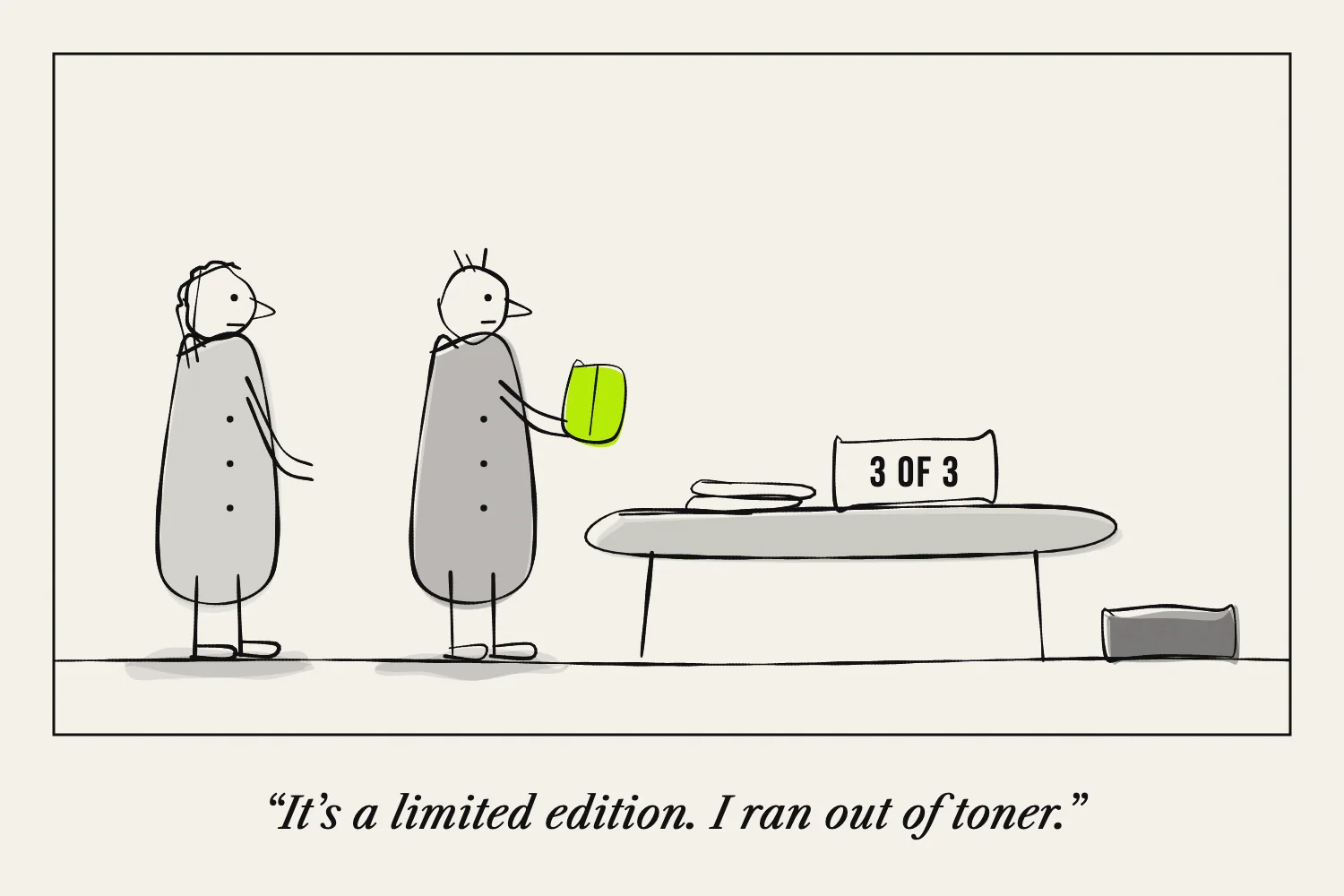
An edition is a version of a publication. A print run is the number of copies produced at one time. People sometimes use those terms loosely, but the distinction helps explain why a zine may be made in small batches.
Zine librarians commonly describe limited print runs as a feature of the form, while acknowledging that there is no single numerical definition. Zinelibraries.info
The reasons below explain the practical choices involved. They should not be read as the motives of every maker.
The intended audience may be small
A zine can be made for friends, a local group or people interested in a narrow subject. It does not need a mass audience to do its job.
If you are making a booklet for ten workshop participants, ten copies plus a few spares may be a reasonable run. That is a planning example, not a standard quantity.
Starting with the audience gives you a better basis for a print decision than trying to look established.
Every copy takes resources
Paper, printing, folding, binding and postage all affect what a maker can produce.
Even when the price per copy falls at a higher quantity, the total bill may rise. A hypothetical quote of 50 copies at $2 each costs $100; 100 copies at $1.50 each costs $150. The lower unit price still requires more money upfront.
Unused copies also need somewhere to live.
Handmade details take time
If each copy includes a hand-coloured cover or a separately attached insert, increasing the quantity increases that work.
A useful way to estimate is to assemble one copy and time the process. Multiply that by the proposed quantity, then allow for mistakes and interruptions.
You may decide to simplify the design or make fewer copies. Either can be a sensible response to the time available.
A small run can leave room to revise
If the first batch reveals an unclear instruction or printing problem, it is easier to correct the next batch when you have fewer unused copies.
Label substantial changes so readers can identify which version they have. “Revised edition” is more informative than quietly replacing content while leaving every detail of the publication record unchanged.
Small does not automatically mean valuable
A low copy count tells you about supply. It does not prove quality, reader demand or future resale value.
Choose a quantity that matches the work and the likely readers. If more people want it, a reprint may be possible.
For your own first batch, see How to Print a Zine at Home.