How Much Writing Does a Zine Need?
Work out how much text your pages need without relying on an arbitrary word count.
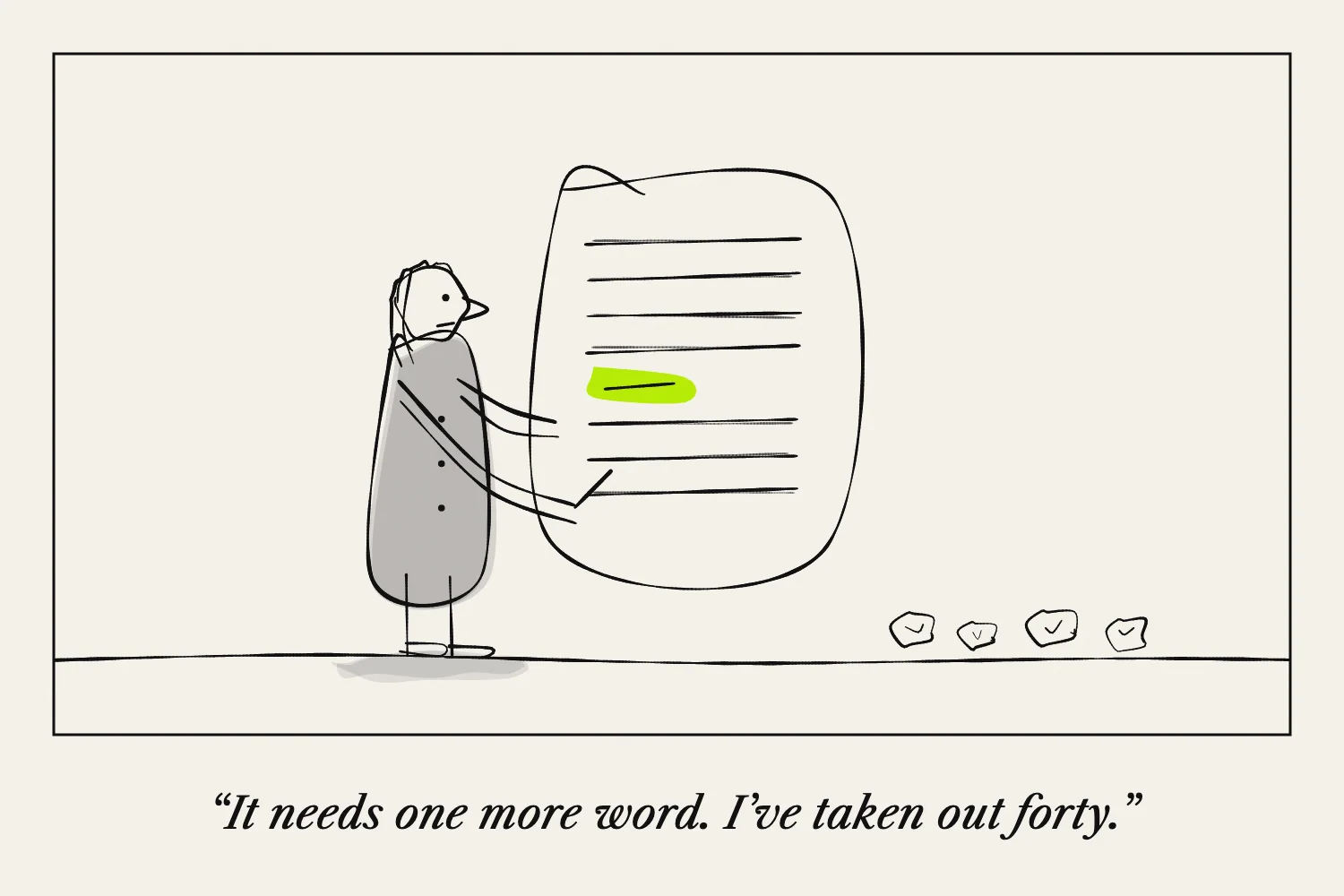
A zine needs as much writing as its idea requires. A photo sequence might need a title and a few captions. A personal essay may use most of the available pages for text. Neither needs to imitate the other.
The important test is whether the reader can follow the work at its finished size.
Decide what the words need to do
Words can explain something the pictures cannot: when an event happened, why an object matters, what a person said, or how one step leads to the next.
Before adding a paragraph, name its job. If a photograph already shows a crowded room, a caption saying “a crowded room” adds little. A caption explaining who gathered there and why gives the reader new information.
For a text-led zine, identify the main question or story. Keep sentences that develop it. Move unrelated observations into notes for a later issue.
Test a real page
Create one page using the type size, margins and column width you intend to use. Print it at the final size.
Read it without zooming in or holding it unusually close. Then ask someone else to try if possible. Different readers need different levels of support, so your own comfort is a starting point rather than a universal standard.
Count the words only after the page feels readable. That gives you a rough capacity for your layout. A word limit copied from another zine may not suit your paper size or design.
Budget space before writing to the limit
An eight-page booklet with two covers leaves six inside pages. If one page is a picture and another carries references, four remain for the main writing.
As a planning example, if your tested layout comfortably holds 100 words per page, those four pages give you roughly 400 words. The number comes from your sample, not a rule that zines should contain 400 words.
Headings, captions and paragraph breaks all use space too. Leave room for them.
Shorten by removing repeated work
Look for sentences that restate the previous sentence, long introductions before the subject begins, and examples that all prove the same point.
Keep the explanation a beginner needs. Removing the definition of an unfamiliar term may save words while making the page harder to understand.
If the material still will not fit, use more pages or divide the topic into issues. Tiny text is rarely a good substitute for making an editorial decision.
Let a page end
There is no need to extend a piece just because space remains. A short ending, a photograph or an empty area can give the reader time to pause.
These are editing suggestions, not a prescribed formula. Use How to Plan an 8-Page Zine to test the balance of writing and images across a whole issue.