Useful Tools for Making Zines
Choose tools for writing, arranging, copying and binding without buying a whole studio.
The best tool for a zine is one that solves a task you actually have. Start by separating those tasks: making the content, arranging pages, producing copies and assembling the booklet.
You can make a first paper zine with ordinary paper, a pen and scissors. Add equipment when the project gives you a reason to use it.
For planning and handmade pages
Scrap paper is useful for testing folds and page order. A pencil lets you mark page boundaries before committing to ink. A ruler helps with straight cuts and consistent margins.
For collage, use a glue stick or another adhesive suited to your materials and test how the finished page scans. Keep thick or loose pieces away from an automatic document feeder.
A cutting mat is useful if you use a craft knife. Scissors may be enough for a simple one-sheet format.
For digital images and text
GIMP is a free image editor that can help prepare photographs, scans and collages. It is useful when the task is changing an image, rather than managing a long document.
Canva provides design tools for arranging text and images. Check that you can create the page dimensions and export format your printer needs before building the whole zine.
A word processor or presentation app you already know may be enough for a simple layout. Make a test export to PDF and inspect it before committing to the tool.
These are options by task, not a ranking or a claim that every feature is free. Product offerings can change.
For making copies
A home printer is convenient for testing, while a copy shop may be useful if you need more copies or a particular finish. Compare the actual job: page size, sides printed, colour, paper and quantity.
Ask for one proof before a larger run. Keep the file and the proof together so everyone is working from the same version.
A scanner helps reproduce handmade pages. A phone photograph can also work if the page is flat, evenly lit and photographed straight on, but check the result closely.
For assembling the zine
A one-sheet slit-and-fold zine does not need staples. A booklet of nested sheets usually needs some way to hold them together.
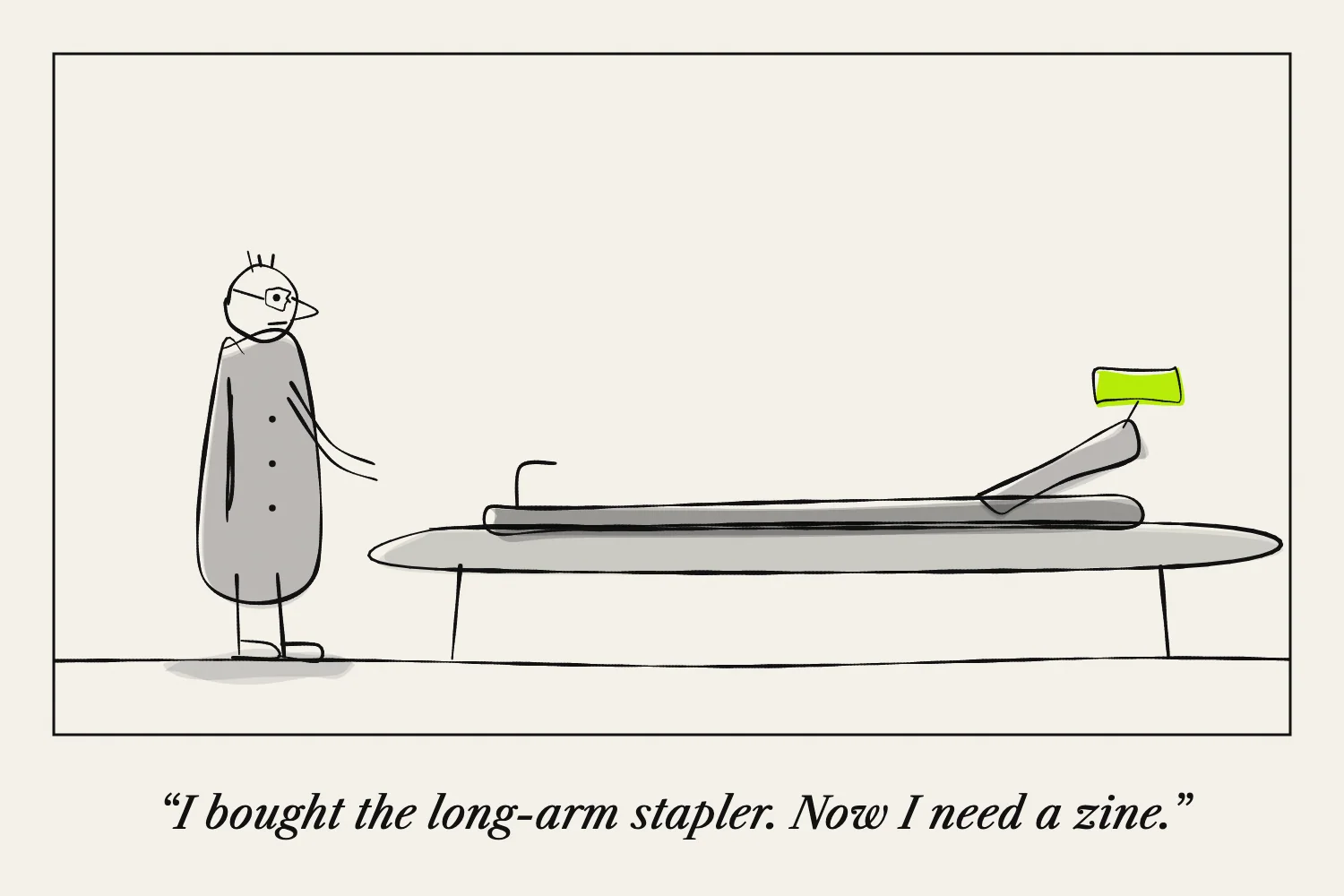
For stapled booklets, check whether the stapler can reach the centre fold. A long-reach stapler is designed to reach farther into a sheet than a small desk stapler.
A smooth folding tool is optional; you can begin by pressing folds carefully with your fingers.
Buy after the trial
Make one complete copy with what you have, then identify the slowest or least reliable step. That gives you a specific reason for a purchase.
A tool that saves time on fifty copies may add little to a one-off project. Let the next zine tell you what equipment would help.
Start with How to Make a Zine.